Someone lands on your booking engine, picks real dates and a real room, gets as far as the guest-details or payment screen — and closes the tab. On a retail site, that moment fires an automated cart-recovery email within the hour. On most hotel websites, it fires nothing. The session just ends, and the only record of it is a line in an analytics funnel report nobody opens twice.
That gap is expensive, because a guest who abandons mid-booking isn't a cold visitor — they're close to the warmest lead a hotel gets. They've already compared your rate to the usual OTAs, already picked real dates, already decided they want to stay with you specifically. Something small pulled them away before they paid — a declined card, a question they wanted to ask first, a second tab with the same dates open on Booking.com, just in case. Whoever answers that moment first usually wins the booking.
Most of the drop-off happens after the hard part
Run the numbers on your own booking engine and the shape is almost always the same: a modest drop between browsing and picking a room, then a much sharper one between picking a room and finishing the form.
The guests worth chasing aren't the ones who bounced off the homepage — they're the ones who cleared the hard part. They chose dates, chose a room, and stalled at the easy part. That's not someone comparison-shopping; that's someone one form field away from a confirmation number.
Speed and specificity beat a discount
The instinct is to treat this like any shopping-cart problem and fire off a generic “still thinking it over?” email with a discount attached. Resist it — a markdown offered to a guest who was already choosing you teaches the same bad lesson as matching an OTA's Black Friday sale: wait a little, and the rate moves.
Reply in the hour, not the next day. By next morning the guest has usually already booked somewhere — quite possibly your own room, through an OTA that will charge you 15% for the introduction. The same reply window that converts a group inquiry works just as hard here; it's just measured in minutes instead of days.
Reference what they actually picked. “Still thinking about the Garden Suite, June 12 to 15?” converts because it proves a person looked, not a script. A named sender who can answer one real question — is the room quiet, does a crib fit, is breakfast included — closes more of these than any rate cut will.
Build the catch into the pipeline, not the booking engine
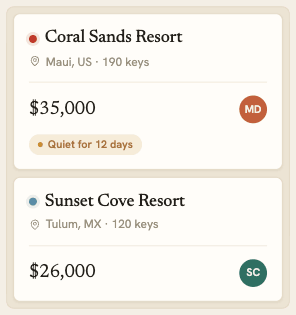
None of this works if the abandoned session lives only in the booking engine's own dashboard, disconnected from whoever would actually send the follow-up. The moment a guest reaches guest-details or payment without finishing, the attempt should land as its own deal — stage, dates, room and value already filled in — so it queues like any other inquiry instead of disappearing into a report nobody checks until month-end.
Most hotels will never close every abandoned session; some guests really were just looking. But the ones who cleared dates, a room and half a form are the easiest conversions anywhere in the pipeline — if someone sees them before the tab closes for good.


Catch the booking before it leaves your site.
Turn a stalled checkout into a deal the moment it stalls — dates, room and value already filled in, queued for a reply within the hour.
Book a demo