
Awedding inquiry is unlike anything else in your pipeline. The value is huge — a room block, an event space, catering, often a rehearsal dinner. The cycle is long, sometimes eighteen months. And the buyer is emotional, first-time, and talking to four other venues this week. Treat it like a normal booking inquiry and you'll lose it to whoever answered faster and felt more certain.
The good news: wedding deals reward process more than charm. Couples don't pick the most charming property — they pick the one that made the next step obvious at every stage. That's a sequence you can build once and run every time.
Reply the same day — with dates, not a brochure
The first touch decides whether you're a contender. Answer within hours, and answer with substance: three real available date options, a starting rate for the block, and one question that moves things forward (“roughly how many guests are traveling?”). A PDF attachment and “let us know if you have questions” is where wedding inquiries go to die.
Make the site visit the pivot
Everything before the visit is qualification; everything after is closing. Push gently but explicitly for a date on property within the first week — a couple that has stood in your garden is no longer comparing venues on price. Prepare like it's a sales meeting, because it is: know their date, their guest count, and have the specific spaces ready to show.
Hold dates with a deadline
After the visit, don't send a quote — send a hold. “I've reserved October 17th and 24 rooms for you until the 30th” converts far better than an open-ended proposal, because it gives the couple something to lose. The deadline also gives you a legitimate, warm reason to follow up twice: once mid-hold, once the day before it expires.
“A couple that has stood in your garden is no longer comparing venues on price.”
Track the planner as their own contact, too. One planner who trusts your property is worth a dozen inquiries a year — long after this couple's big day, the planner is still booking blocks.
Where the CRM earns its keep
None of this is complicated. What makes it fail in real life is volume: twenty open wedding threads across three inboxes, each at a different stage, each with a hold expiring on a different day. In Avero, each inquiry is a deal with its dates, its hold deadline and its next action visible — and an automation nudges you (or the couple) when a hold is about to lapse.
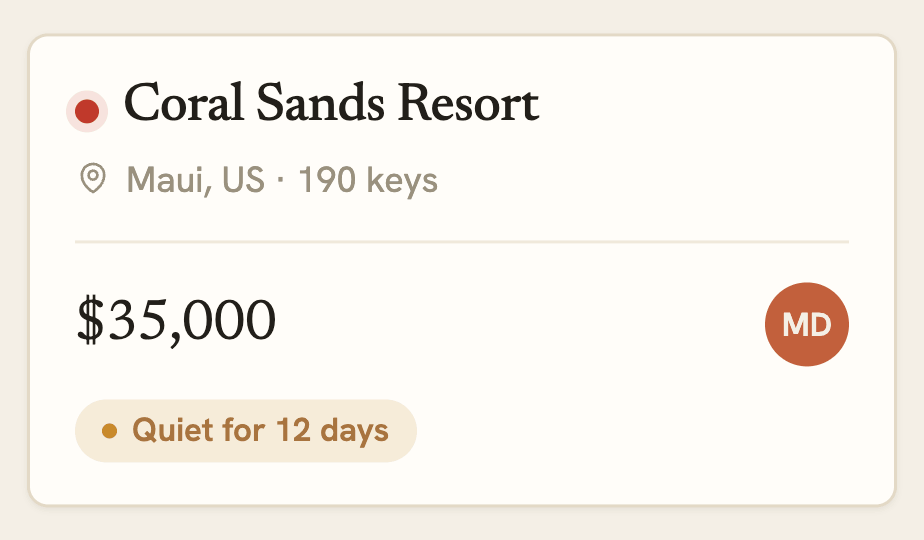
Run the sequence, keep the deadlines honest, and wedding season stops being a scramble. It becomes the most predictable revenue on your calendar.



Run your wedding pipeline in one calm place.
Every inquiry, site visit and hold deadline on one board — with follow-ups that send themselves. See it live.
Book a demo